

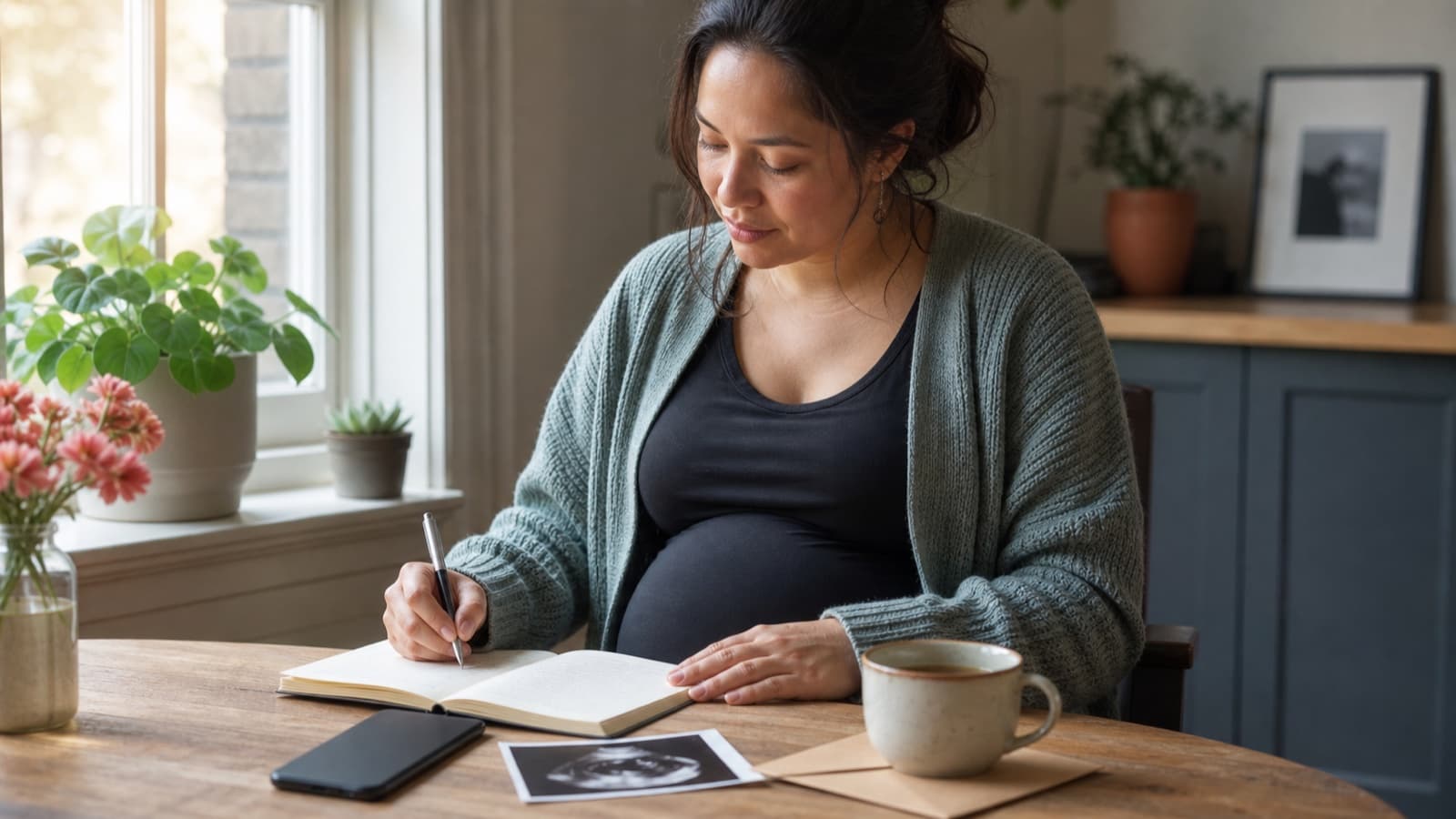
How to Create a Pregnancy Journal You Will Actually Keep
A pregnancy journal does not have to begin with a perfect announcement and continue every week without a gap.
It can begin at week 6, week 26, during an adoption or surrogacy journey, after a complicated appointment, or on the evening you finally feel ready to write. It can hold joy, uncertainty, nausea, practical lists, donor or family stories, ordinary Tuesdays, and feelings that do not fit a cheerful prompt.
The best pregnancy journal is not the most decorated one. It is the one that makes it easy to save honest details before they blur together.
This guide shows how to choose a format, build a simple structure, use prompts without turning the journal into homework, preserve photos and keepsakes, and carry the story naturally into a baby memory book.
What Is a Pregnancy Journal For?
A pregnancy journal can do several jobs, but it does not need to do all of them.
| Purpose | Examples |
| Personal reflection | Feelings, changing identity, hopes, worries, surprises |
| Family story | How the child was hoped for, conceived, carried, welcomed, or joined the family |
| Memory record | Photos, movements, names considered, family reactions, preparation |
| Practical notes | Questions for appointments, useful products, plans, contact details |
| Future keepsake | Letters, ultrasound copies, stories, and pages for a baby book |
Keep medical records, test results, medication information, and instructions from your care team in the system they recommend. A personal journal can hold questions and reflections, but it should not be the only place you store information needed for care.
Step 1: Choose the Format With the Lowest Friction
You have three good options.
Paper Journal
Choose paper if handwriting, drawing, and physically attaching keepsakes make you want to return.
Useful formats include:
- A blank notebook
- A guided pregnancy journal
- A ring binder with movable pages
- A scrapbook with photo-safe materials
- A small weekly diary
A binder is forgiving because pages can be added, removed, or reordered. A guided book is helpful when you like prompts, but check that its language and family assumptions fit your story.
Digital Journal
Choose digital if your phone is where photos, quick notes, and voice recordings already live.
Look for:
- Easy photo and video upload
- Private access controls
- Backup and export options
- Searchable dates
- Flexible entries rather than compulsory weekly forms
- A path from saved memories to a finished PDF or book
Hybrid Journal
Choose hybrid if you want quick digital capture and a physical result.
Use one digital place as the working journal. At the end of each trimester or after the birth, select a smaller set of entries for paper. This avoids maintaining two full journals at once.
Step 2: Set Up Seven Flexible Sections
You can create these as tabs, folders, tags, or headings.
1. Before We Knew
Include only what belongs in your story:
- Hopes or decisions before pregnancy
- Fertility treatment, donor conception, surrogacy, or adoption context
- The people who supported the journey
- What family life looked like then
- A letter from before the positive test or confirmation
This section can be joyful, difficult, private, short, or omitted entirely.
2. Finding Out
Record the facts and the real reaction, even if the feelings were mixed.
- Date or approximate time
- Where you were
- Who knew first
- How you told someone, if you did
- What you did next
- What surprised you about your response
3. First Trimester
Keep entries small. Fatigue, nausea, uncertainty, work, and ordinary responsibilities may leave little room for a weekly essay.
One line is enough:
Week 10: Crackers in every coat pocket, asleep by eight, and still checking the scan photo each morning.
4. Second Trimester
This section might include changing clothes, movements, appointments, name ideas, telling people, preparation, or simply daily life.
5. Third Trimester
Save the practical and emotional ending of the wait:
- Home preparations
- Questions and decisions
- Family visits
- Final photos
- What feels exciting, uncomfortable, uncertain, or close
- A note to read after the birth or arrival
6. People Waiting With Us
Invite short notes from the people who will belong in the child's life: a partner, co-parent, sibling, grandparent, donor, surrogate, aunt, uncle, friend, godparent, or chosen family.
7. Birth, Arrival, and the First Days
Leave blank space. The story may not unfold as expected, and there is no need to pre-write its shape.
Afterward, record what you want to remember in your own time. A birth story is optional. An arrival can be documented through feelings, people, first photos, and homecoming rather than medical detail.
Step 3: Pick a Routine You Can Miss
A useful routine is one that survives interruption.
Choose one trigger:
- After an appointment
- At the start of each new month
- When you take a bump or family photo
- After someone asks a question you want to remember
- When a movement, craving, worry, or funny event feels specific
- Sunday evening, if weekly reflection suits you
Then choose a minimum entry:
Date or week:
One thing that happened:
One feeling:
One detail I do not want to forget:
That can take two minutes. Longer entries are welcome, not required.
Step 4: Use Prompts That Leave Room for the Truth
Prompts should open a door, not demand a particular emotion.
Finding-Out Prompts
- What happened on the day I found out or received confirmation?
- What was my first practical thought?
- Who did I want to tell, and why?
- What part of the story belongs only to me for now?
- What did home, work, and family life look like that week?
First-Trimester Prompts
- What helped me get through this week?
- Which food, smell, object, or routine defines this stage?
- What surprised me physically or emotionally?
- What question did I bring to an appointment?
- Who offered support in a way I remember?
- What have I not felt ready to plan yet?
- What small moment made the pregnancy feel real?
Second-Trimester Prompts
- How would I describe the first movement I noticed?
- What time of day feels most peaceful or lively?
- Which name is on my mind, even if it is not the final choice?
- What has changed in my daily routine?
- Which family story do I want this child to know?
- What have siblings or relatives said?
- What did I wear, carry, eat, or listen to repeatedly this month?
- What is easier now, and what is harder?
Third-Trimester Prompts
- What does the home look like as we prepare?
- Which task feels important, and which can wait?
- What do I want my future self to remember about today?
- What am I looking forward to learning about this child?
- Who is part of the support plan?
- Which ordinary routine will change soon?
- What am I proud of from this pregnancy?
- What do I need more or less of right now?
Family and Identity Prompts
- How did our family come to have this particular shape?
- Which traditions do we want to carry forward?
- Which traditions are we choosing to change?
- What do I hope this child always knows about belonging here?
- Who was waiting to meet them?
- What did loved ones contribute during the pregnancy?
Letter Prompts
- Here is what I know about you so far...
- Here is what I want to show you one day...
- Here is what made me laugh this month...
- Here is what I hope our home feels like...
- Here is something difficult we moved through...
- Here is the ordinary detail I hope I never forget...
Pick one prompt, not all forty. Repeating the same prompt in each trimester can reveal more than constantly finding a new one.
Step 5: Add Photos and Keepsakes With Context
A keepsake is easier to understand later when it has a date and one line of explanation.
Consider saving:
- Pregnancy-test packaging or a photograph, if meaningful to you
- Ultrasound images or digital copies
- Monthly or occasional body photos
- The place where you shared news
- A list of names considered
- A card or message from family
- A nursery sketch or shopping list
- A playlist
- A piece of fabric or a clothing label
- A letter from a sibling or loved one
- Photos of everyday life, not only appointments and announcements
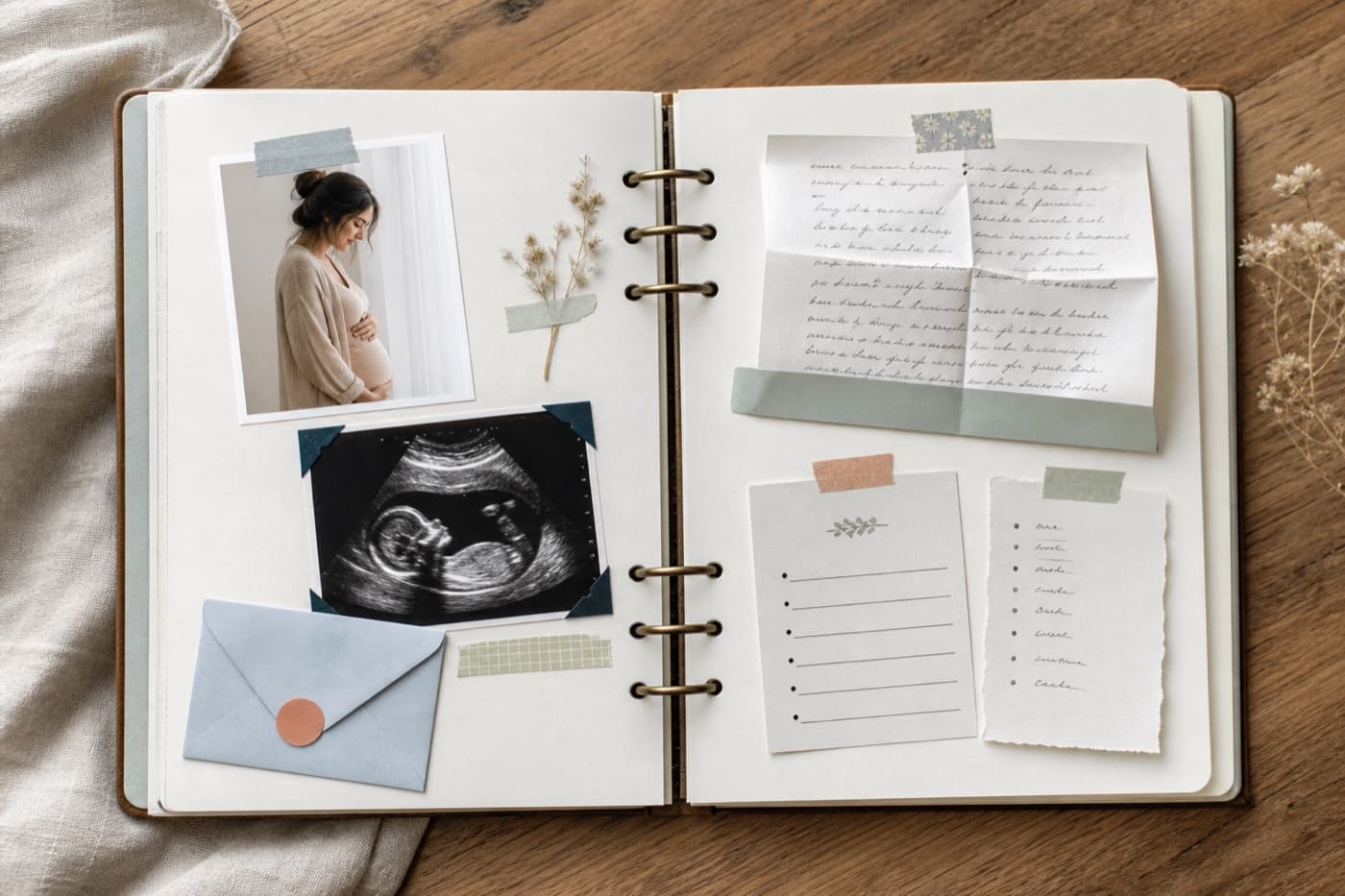
For each item, add:
- Date or stage
- People involved
- Why you kept it
- What happened just before or after
Photograph or scan unique paper items before attaching them permanently. The U.S. National Archives provides practical guidance for handling, storing, and digitizing family papers and photographs.
Step 6: Let Other People Add Their Own Voice
A pregnancy journal does not have to be written by one person.
Ask someone close to answer one specific question:
- What do you remember about the day you heard the news?
- What are you most looking forward to doing together?
- Which family story should this child know?
- What changed in our home during this pregnancy?
- What do you hope they call you?
- What is one thing you noticed about me during this time?
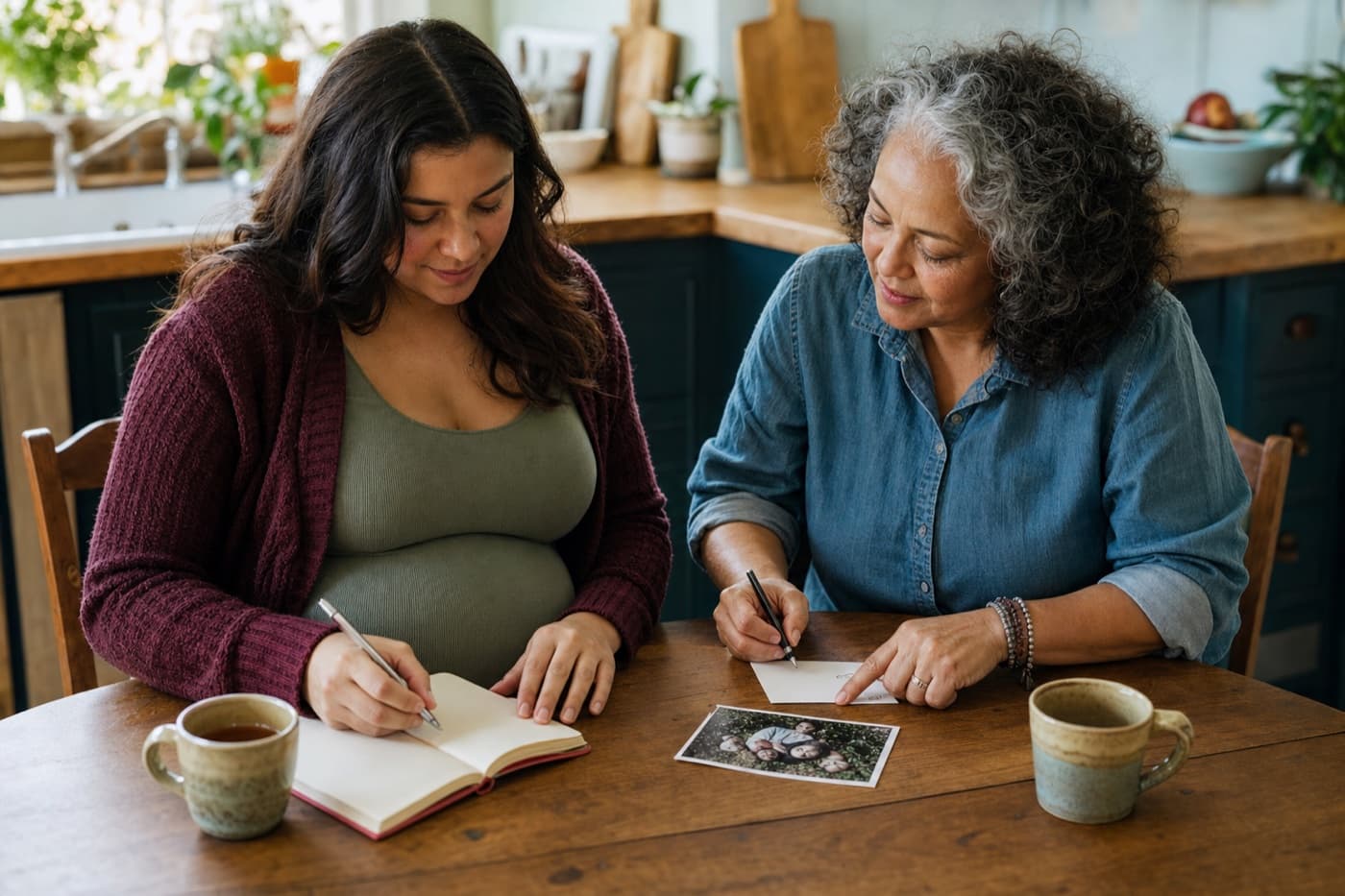
Separate voices are especially valuable when family lives far away or when more than one person has a role in the child's arrival story. Preserve each person's own wording rather than blending every note into one polished narrator.
Step 7: Keep Medical Notes Separate From the Keepsake
It is reasonable to jot down questions before an appointment or reflect afterward. But a future family keepsake and an active care record have different jobs.
Use a separate, easy-to-find place for:
- Current medication and allergy information
- Instructions from your care team
- Appointment times and contact details
- Test results and formal records
- Questions requiring medical answers
Use the journal for:
- What the day felt like
- Who came with you
- What you want to remember
- Decisions and their personal context
- A private reflection you may or may not include in the final book
Contact your care team about medical concerns rather than relying on a journal prompt, pregnancy app, search result, or AI-generated answer.
Step 8: Build a Catch-Up Method for Missed Weeks
Do not begin by filling the earliest blank page. Begin with today.
Then recover earlier memories using evidence:
- Check the dates on photos.
- Look at calendar appointments.
- Search messages sent to family.
- Review notes or voice recordings.
- Ask another person what they remember.
- Label uncertain dates honestly as "around week 18" or "late spring."
Write a trimester summary instead of reconstructing every week:
What changed:
What was difficult:
What brought comfort:
Who was present:
Three details I remember:
One photo that represents this stage:
An honest summary is better than invented precision.
Step 9: Carry the Pregnancy Story Into the Baby Book
The pregnancy journal does not need to become a separate finished project that ends on a shelf.
Select a small bridge into the child's later book:
- How the family hoped for or prepared for the child
- One finding-out story
- One image from each trimester or stage
- A family note
- The name story
- One letter written before meeting
- The final days before birth or arrival
- The first photograph that begins the next chapter
In Magic Baby Books, parents can save pregnancy-story and ultrasound moments with photos, dates, text, and voice-assisted memories in the child's private timeline. The same timeline can continue after birth with everyday stories, milestones, photos, and videos.
Parents choose which moments to share with invited family. Viewers can follow, react, and comment; contributors can also add their own moments. Later, selected timeline moments can become a print-ready keepsake book or PDF.
Mobile and web have the same core functionality. You can create and continue the journal entirely on either platform, or use both. A larger screen is only an optional convenience when reviewing many photos or arranging the final book.
For the camera-roll side of the process, use this baby-photo organization workflow to keep scans, monthly photos, and later baby pictures findable.
A One-Page Pregnancy Journal Template
Use this whenever you want structure without a long entry:
Date:
Pregnancy week or stage, if useful:

Today:

What my body and mind felt like:

One person, place, sound, object, or food from this stage:

What changed since the last entry:

One question or uncertainty:

One thing I want to remember:

Photo, scan, or keepsake:
Delete any line that does not help.
Frequently Asked Questions
When should I start a pregnancy journal?
Start whenever you want to remember from. There is no deadline and no requirement to begin with a positive test. Today is a valid first page, even late in pregnancy or after the child's arrival.
Should I write in my pregnancy journal every day?
No. Write after meaningful moments, at a monthly check-in, after appointments, or when a detail feels worth saving. A sustainable journal can contain short and irregular entries.
What should I include in a pregnancy journal?
Include the parts meaningful to you: feelings, family context, photos, movements, daily routines, names, support, preparation, questions, letters, and the story of birth or arrival if you want it recorded.
Is a digital or paper pregnancy journal better?
Digital is convenient for quick capture, media, editing, backup, and family contributions. Paper offers handwriting and a tactile keepsake. A hybrid approach lets you collect digitally and print a thoughtful selection later.
What if my pregnancy has been difficult or uncertain?
The journal does not need a cheerful tone or a complete record. Keep entries private, skip prompts, write only facts, pause entirely, or ask someone trusted to help. Record the story in the way that feels supportive to you.
Can I include medical information?
You can reflect on appointments and keep a list of questions, but use the record system recommended by your care team for information needed for medical care. Seek medical guidance from qualified professionals, not from journal prompts or generated content.
How do I include a partner, donor, surrogate, or chosen family?
Give each person space to write in their own voice. Ask about what they remember, what role they played, what they hope to share with the child, or which family story matters to them. Include only the details and language your family wants preserved.
Begin With One Honest Entry
You do not need the right notebook, a complete set of weekly photos, or certainty about how the story will end.
Write the date. Describe one thing that happened. Name one feeling. Save one detail that would otherwise disappear.
That is already a pregnancy journal, and it is enough to begin.