

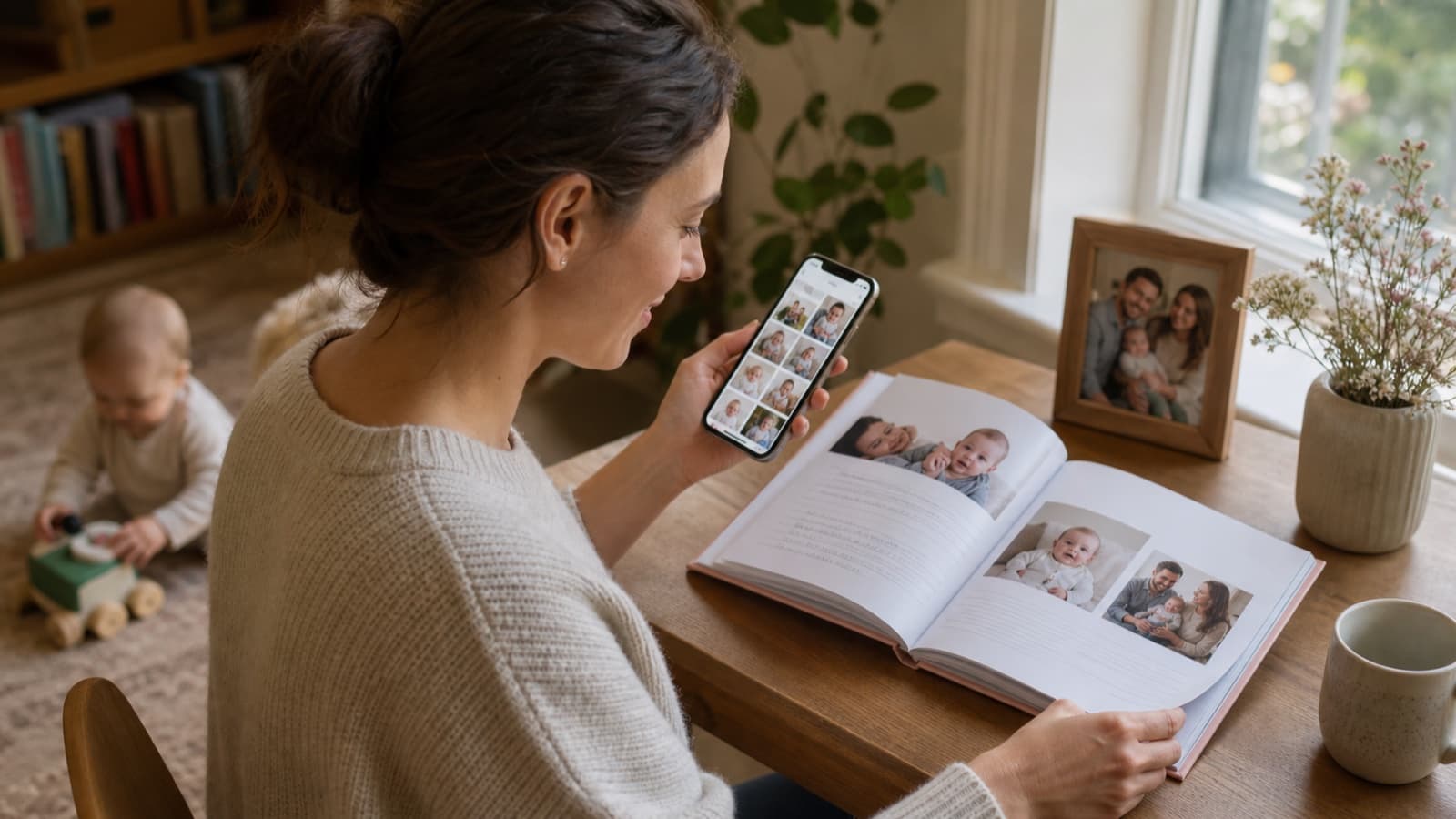
Digital vs. Physical Baby Books: Which One Fits Your Family?
A physical baby book is lovely when it is in your hands. But a preprinted baby book can also become a quiet list of things you did not complete: the milestone that happened differently, the family page that does not fit, or the empty month you keep meaning to return to.
A digital baby book is useful when the memory is happening, but its deeper advantage is flexibility. You can begin today, skip a milestone that does not belong to your story, add the people who actually make up your family, and arrange the final book around the childhood you had rather than a template you were expected to complete.
That is the real tension behind the digital-versus-paper decision. Digital is easier to adapt while life unfolds. Paper creates a finished object that can be opened without a password, screen, or subscription. Neither is automatically better, and many families do best with a hybrid: collect memories flexibly, then turn a thoughtful selection into a printed book or PDF.
This guide compares digital and physical baby books without invented time estimates or one-size-fits-all promises. Use it to choose the system you are most likely to keep using.
The Short Answer
Choose a digital baby book if your priority is flexibility: beginning anywhere, recording the milestones and ordinary moments that matter to your family, editing later, including video, and sharing selected updates with people in different places.
Choose a physical baby book if your priority is handwriting, tactile keepsakes, screen-free browsing, and owning a finished object from the start.
Choose a hybrid system if you want easy capture now and a physical keepsake later.
Digital vs. Physical Baby Books at a Glance
| Question | Digital baby book | Physical baby book |
| Where do you update it? | Phone, tablet, or computer, depending on the service | Wherever the book and supplies are |
| What can it hold? | Text, photos, video, audio, dates, comments, and links, depending on the app | Handwriting, printed photos, drawings, cards, and flat keepsakes |
| What happens if you miss a milestone? | Skip it, add another kind of memory, or return later without leaving a visible blank | A preprinted prompt or empty page may remain |
| Can it fit different family structures? | Flexible systems can use the people and relationships you choose | Depends on whether the printed prompts match your family |
| Must entries stay in a fixed order? | Usually easy to add, edit, select, or rearrange | Bound and preprinted pages may set the sequence |
| Can you edit mistakes? | Usually easy to revise | Correction may be visible or require covering a page |
| Can distant family follow? | Often, if private sharing is supported | Usually through visits, photos of pages, or duplicate copies |
| What can damage it? | Account loss, service closure, forgotten passwords, file-format change | Fire, water, light, mold, insects, spills, or physical loss |
| What does backup require? | Exports and copies outside the service | Scans, photographs, or a duplicate book |
| What does it cost? | May involve a subscription, storage, export, or printing fees | Book, photo printing, supplies, storage, and replacement costs |
| What is it best at? | Flexible capture and organization | Tangible experience and display |
The practical question is not "Which format has more features?" It is "Which format removes the obstacle that usually makes me stop?"
The Advantages of a Digital Baby Book
Follow the Child Instead of the Template
A flexible digital baby book does not need every child to reach the same milestone in the same month or every family to introduce the same set of relatives.
You can:
- Skip crawling and record the unusual way your child moved instead
- Save three pages about a beloved grandparent and none about a relationship that is not part of the family
- Use the language your family uses for parents, donors, surrogates, caregivers, and chosen family
- Give an ordinary routine more space than a traditional milestone
- Begin at eight months without creating seven empty monthly pages
- Make one year detailed and another year brief
The book becomes a record, not a test. Missing a milestone entry does not mean you failed to notice your child. It only means life did not arrive in preprinted order.
Capture a Memory Where It Happens
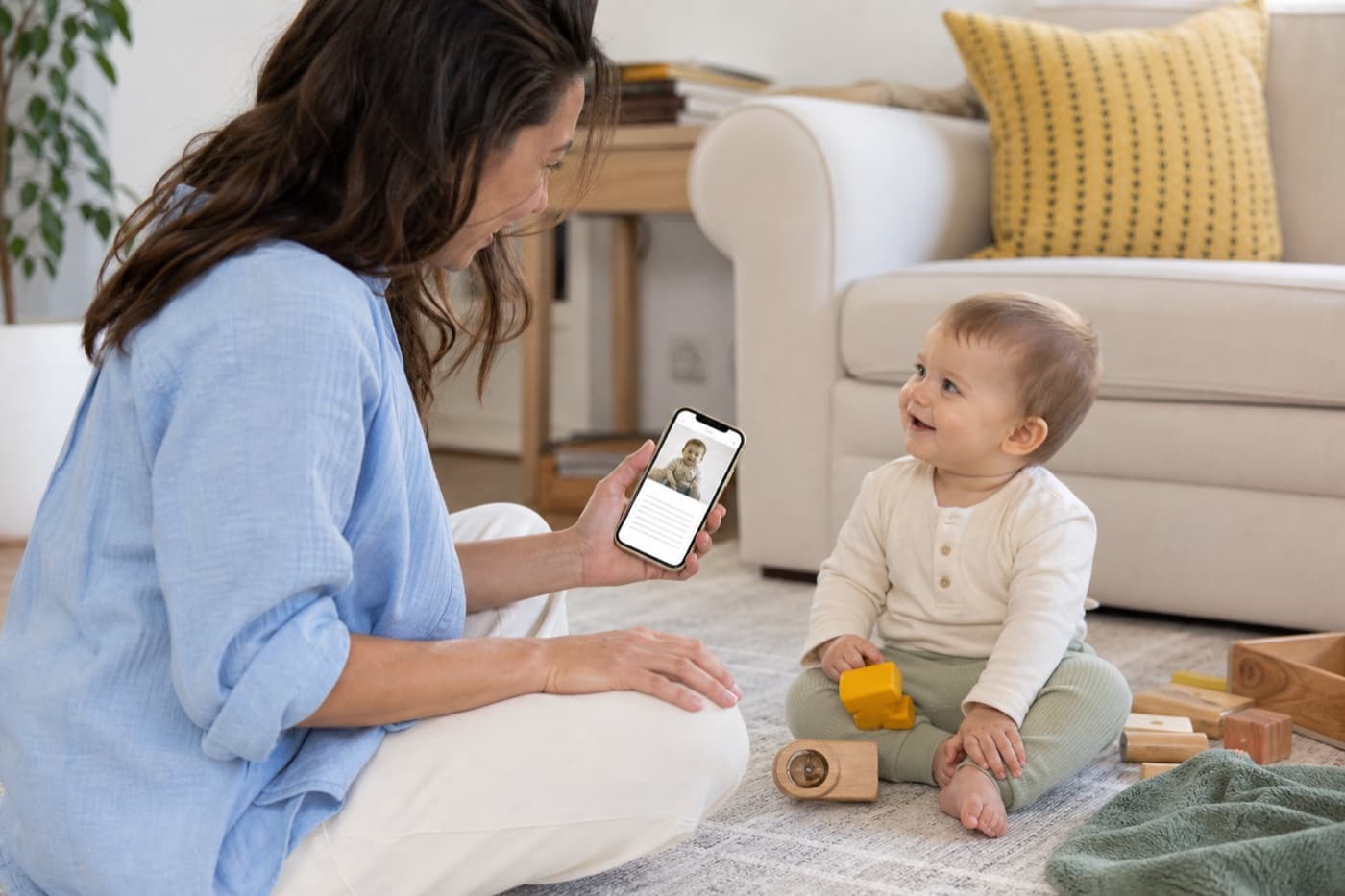
Your phone is often nearby when a first word, funny sentence, or ordinary family moment happens. A digital system lets you add one photo and one sentence before the details fade.
That matters because the story behind a picture is easier to record today than reconstruct six months later.
Keep More Than Still Photos
A digital timeline can preserve media that paper cannot play:
- Short videos
- Baby sounds and early words
- Voice-assisted memories
- Several photos from one event
- Family comments attached to a moment
- Dates and tags that support later searching
A printed book can include a still image and written description from a video, but the original clip still needs a digital home.
Edit and Catch Up More Easily
Digital entries can usually be corrected, reordered, or expanded. If you begin when your child is eight months old, you can add today first and work backward gradually.
That flexibility is useful for parents who avoid paper books because one blank week seems to spoil the whole sequence.
Share Selectively With Family
Some digital baby books support private invitations, roles, comments, or contributions. That can keep distant grandparents, siblings, aunts, uncles, donors, and chosen family close without putting a child's everyday life on a public feed.
Check what "private" means in the specific service. Look for individual accounts, clear access controls, deletion options, and an explanation of what invited people can see.
Start the Book From Memories You Already Saved
The blank-page problem is smaller when stories, dates, and photos already exist as timeline moments. Instead of trying to remember a year while designing pages, you select from material captured over time.
The Limitations of a Digital Baby Book
A Service Is Not the Same as a Backup
Cloud storage is convenient, but no app should be the only copy of memories you want to keep for decades.
Accounts can be locked, products can change, companies can close, and file formats can become inconvenient. Look for exports in useful formats and keep copies outside the service.
The U.S. National Archives' guidance on preserving digital memories recommends identifying the digital material that matters, organizing it, making copies, and checking those copies over time.
Screens Can Encourage Accumulation Instead of Selection
It is easy to save everything and finish nothing. A useful digital workflow needs a small selection habit:
- Save the meaningful moment, not every near-duplicate
- Add enough context that it still makes sense later
- Review favorites monthly or seasonally
- Export or print finished collections
If your camera roll is already crowded, start with this simple baby-photo organization system.
Privacy Requires Active Choices
Digital sharing can be more private than public social media, but only when settings and invitations are managed carefully.
Review:
- Who owns the account
- Who can invite others
- Whether links can be forwarded
- What contributors may add or edit
- How to remove access
- Whether location or other metadata is exposed
- How to download and delete data
Costs May Continue
A digital service may charge for subscriptions, storage, premium features, exports, or printed products. Compare the complete workflow you need rather than only the entry price.
The Advantages of a Physical Baby Book
It Is Already a Finished Object
A paper book lives on a shelf. A child can pull it out, a grandparent can open it, and nobody needs to remember a login.
The handwriting, crossed-out word, taped card, and slightly crooked photograph become part of the family record.
It Gives Keepsakes a Natural Home
Paper books can hold flat objects that do not feel the same as scans:
- A hospital card
- A baby-shower note
- A lock of hair in a secure envelope
- A footprint card
- A small drawing from an older sibling
- A pressed flower or fabric swatch, stored with suitable materials
Photograph or scan unique items before attaching them permanently.
It Encourages Editing Through Physical Limits
A printed page cannot hold 140 pictures comfortably. That limitation forces a decision: which three images tell the story?
The result may be easier to revisit than a limitless archive.
It Creates a Screen-Free Family Ritual
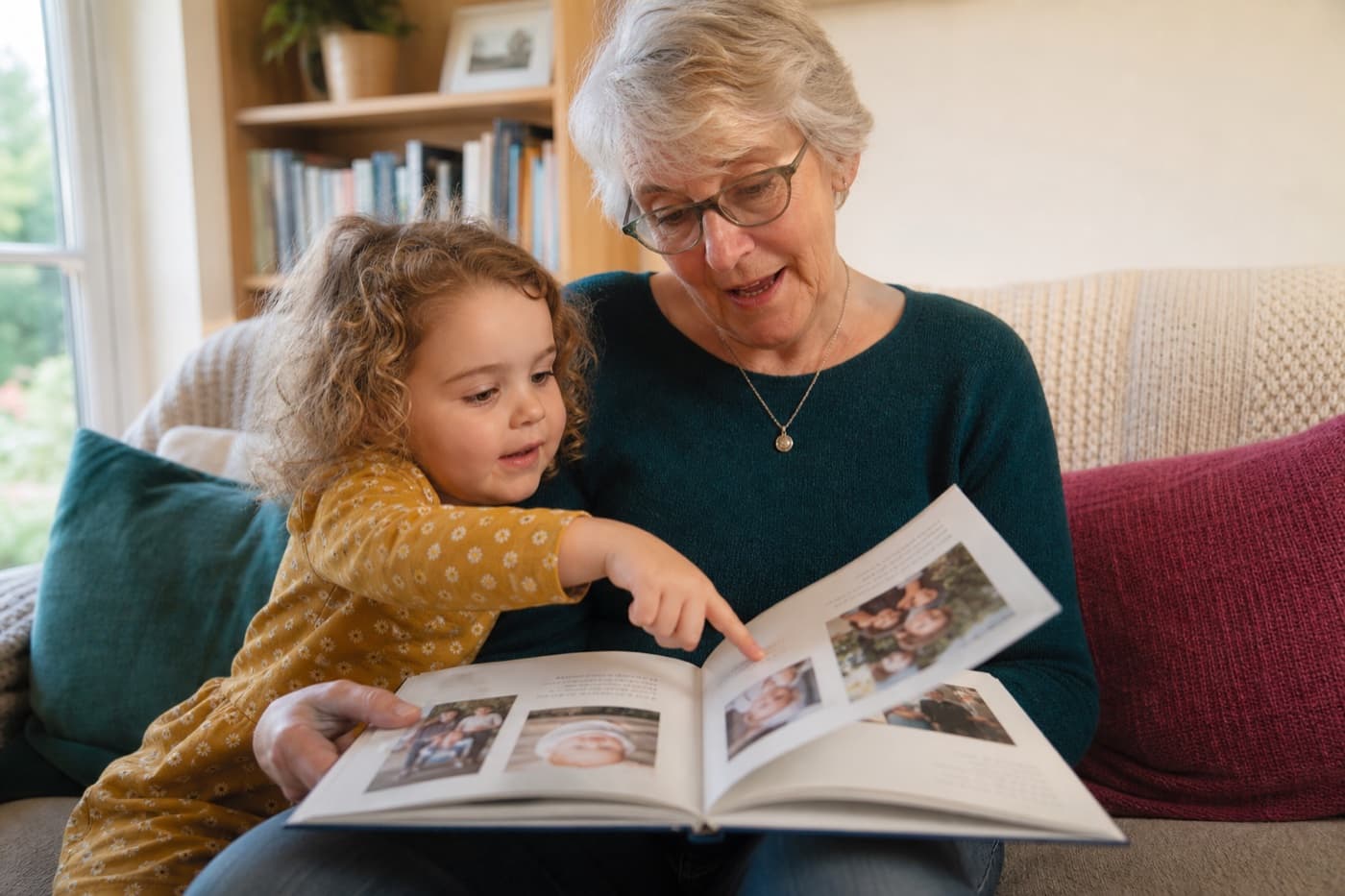
Turning pages together is slow in a good way. Children can point, ask questions, and learn who is in the pictures without notifications arriving over the top.
The Limitations of a Physical Baby Book
You Need the Book and Materials Nearby
The moment may happen in the park while the book is at home. If you rely on memory until the next journaling session, details can disappear.
A notes app, voice note, or private timeline can act as an inbox even if paper remains the final destination.
Preprinted Prompts Can Turn Gaps Into Guilt
Preprinted books may assume a family structure, birth story, timeline, or set of milestones that does not fit. A page labeled for "Dad's family," a compulsory birth narrative, or twelve identical monthly spreads can make a loving book feel like paperwork you are completing incorrectly.
Blank pages are not evidence that a parent cared less. They usually mean the book asked for the wrong thing at the wrong time.
Look for flexible prompts, movable pages, or a format that allows you to skip sections without the book appearing incomplete.
One Copy Is Vulnerable
A paper book can be damaged or lost. The U.S. National Archives' family archive guidance covers careful handling, storage, display, and digitization of family papers and photographs.
For a family baby book:
- Keep it away from direct sunlight and unstable heat or humidity
- Avoid basements, attics, and places vulnerable to leaks
- Use photo-safe materials
- Scan or photograph completed pages
- Keep the digital copy somewhere separate
Distant Family Cannot Naturally Gather Around the Same Copy
You can photograph pages or order duplicates, but comments and new contributions do not attach themselves to the original. If family participation matters during the year, a digital layer is usually easier.
Which Format Fits Your Situation?
Choose Digital First If...
- You want the book to fit your family constellation instead of adapting your family to fixed prompts
- Empty milestone pages make you feel behind
- You want to begin with today and leave earlier gaps alone
- You take most photos on your phone
- You want to include video or sound
- You prefer short updates over scrapbook sessions
- Important family members live far away
- You want to edit and rearrange later
- You are already behind and need a forgiving starting point
- Your family structure does not fit traditional printed prompts
Choose Paper First If...
- Handwriting and physical craft are part of the meaning for you
- You enjoy selecting and printing photos regularly
- You want a screen-free keepsake from the beginning
- You have flat memorabilia you want to preserve
- You prefer a finite number of pages
- You do not want an ongoing service relationship
Choose Hybrid If...
- You want quick capture and a tactile result
- Several family members contribute photos or stories
- You want video preserved even though the final book is printed
- You like editing digitally before committing to paper
- You want both an accessible working archive and a finished annual book
A Hybrid Workflow That Does Not Duplicate the Work
Hybrid should mean one capture process and two useful outputs, not maintaining two parallel journals.
During the Week: Capture
Save the photo, video, quote, or story digitally. Add the date and one specific detail.
Once a Month: Select
Choose a small set of moments that add something different:
- One portrait
- One everyday routine
- One relationship
- One change or milestone
- One funny or difficult moment
Monthly portraits can use baby milestone cards, but the story should not depend on a perfect series.
Once or Twice a Year: Finish
Turn the selected moments into a printed book or print-ready PDF. Keep the full digital timeline for videos, longer stories, and family comments that do not fit on every page.
For a birthday chapter, this first-birthday photo list helps create variety without saving dozens of identical shots.
How Magic Baby Books Bridges Digital and Physical
Magic Baby Books is designed around a hybrid sequence:
Capture once. Share with family. Create books later.
Flexibility is the reason the product exists. Its founder, Jenny, went looking for a first-year baby book while expecting her oldest daughter. As a solo mother by choice with donor-conceived children, she found books built around a dad and a dad's side of the family. She bought one anyway and crossed out the pages that did not fit.
Years later, the half-finished book still contained empty photo spaces and good intentions. Magic Baby Books grew from the wish for something that would fit the family first, allow memories to be captured when possible, and never turn an unrecorded milestone into a page of guilt.
Parents can save stories, milestones, quotes, photos, videos, and voice-assisted memories in a private timeline for each child. They choose which moments invited family can see. Viewers can follow, react, and comment; contributors can also add their own moments. Invited family joins free, while the parent who owns the timeline manages the subscription.
There is no required monthly sequence to complete before moving on. Parents choose the moments, relationships, labels, and chapters that belong in their child's story, then choose what enters the final book.
When enough material exists, the parent selects timeline moments, chooses a cover and page style, adjusts the design, and exports a print-ready PDF. Magic Baby Books does not require you to capture on a phone and finish on a computer. Mobile and web provide the same core functionality, so either can handle the whole workflow. The web app is simply an optional larger-screen workspace.
This preserves the strength of digital capture without giving up the goal of a book you can hold.
Questions to Ask Before Choosing Any Baby-Book System
- Can I start with the current month instead of filling every earlier gap?
- Does it fit my actual family without pages I must cross out?
- Can I include stories as well as photos?
- Can I preserve video or audio somewhere?
- Who can see the memories?
- Can relatives contribute without taking over the book?
- Can I correct names and dates later?
- Can I export the original material and a finished book?
- What happens if I stop paying or the service closes?
- How will I keep a second copy?
- Will I enjoy returning to the finished result?
The answers matter more than whether the cover is labeled "digital" or "traditional."
Frequently Asked Questions
Is a digital baby book better than a physical one?
Digital is usually easier for quick capture, editing, video, and private long-distance sharing. Physical is stronger as a tactile, screen-free object. The better choice is the one that fits the obstacle you actually face, and a hybrid often provides both benefits.
Will a digital baby book last forever?
No storage method lasts forever without care. Export important memories, keep copies in more than one place, use common file formats, and check the archive periodically. Do not treat one app account as the only backup.
How do I protect a paper baby book?
Use photo-safe materials, store it in a dry and stable indoor location away from direct sunlight, handle it with clean hands, and digitize completed pages. Keep the digital copy in a separate location.
What if I already started a paper book and stopped?
Keep the pages you completed. Start capturing current memories digitally, then return to the paper book with a small selection when you have time. You do not need to reconstruct every blank week.
What if a traditional baby book does not fit my family?
Do not force real relationships into prompts written for somebody else. Choose a flexible book or timeline where you control the people, labels, stories, and sections. A baby book should document your family, not grade how closely it resembles a template.
Can family members help with a digital baby book?
It depends on the service. In Magic Baby Books, invited viewers can follow shared moments, react, and comment. Contributors can also add moments to the child's timeline. The parent controls what is shared.
Can I make a printed book from Magic Baby Books?
You can select saved timeline moments, adjust the book design, and export a print-ready PDF. This lets you create a physical keepsake while preserving the original digital timeline and media.
Do I need both the mobile and web apps?
No. Mobile and web have the same core functionality. Use either one for capture, organization, sharing, editing, and book creation, or switch between them when convenient.
Choose the System That Helps You Finish
A paper book is not automatically more meaningful, and a digital book is not automatically more complete. The strongest case for digital is that it can bend around real life: missed months, unexpected milestones, changing plans, and families that do not fit a preprinted family tree.
Meaning comes from the choices inside it: the true story, the people included, and the ordinary details someone took time to save.
Use digital tools where they remove friction. Use paper where it creates connection. Keep a second copy of what matters.
The best baby book is not the one with the longest feature list. It is the one your family can add to now and still open years from now.